
Prepare the data and the steering rules
The continuity of supply depends on the synchronization between physical flows, decisions, and the production schedule. Storage and transport execute this schedule, but do not define either purchasing priorities or industrial trade-offs.
190.7 billion CHF of Swiss imports come from the EU, including 63.7 billion from Germany and 20.4 billion from France in 2025, highlighting the importance of coordinating multiple European suppliers (source: OFDF).
Before building the flow, gather the following prerequisites:
- nomenclatures, references, and any authorized substitutions;
- suppliers and shipping origins;
- production sites, warehouses, and internal destinations ;
- forecasts, manufacturing orders, and purchase orders ;
- available, reserved, controlled, and in-transit stocks ;
- supplier lead times and transport times;
- receiving constraints and available slots;
- Incoterms, customs status, and tariff data, if applicable;
- temperature, safety, and handling requirements.
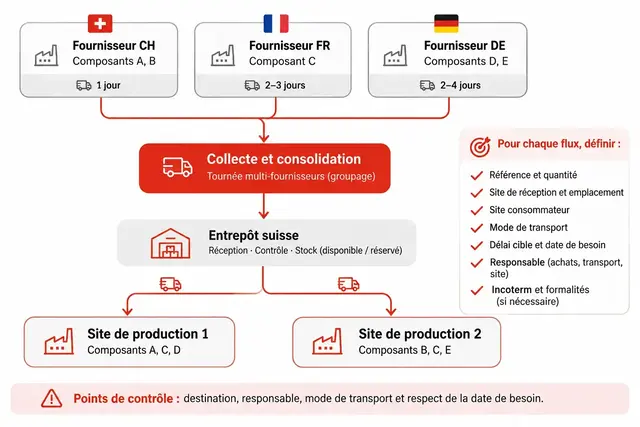
Le fil rouge est fictif. Un fabricant suisse exploite 2 sites de production et reçoit des composants de fournisseurs suisses, français et allemands.
▣
Component
▤
Key data
☑
Control
◉
Responsible
⚑
Corrective action
▣
Critical
for the line
▤
Planned
consumption, available and reserved stock, required date, authorized substitutes
☑
Check
coverage before each assignment to the program
◉
Production
planning
⚑
Reserve
the stock, check the other site and enter the purchases
▣
Long
lead time
▤
Confirmed
lead time, open order, shipping date, stock in transit
☑
Regularly
compare the confirmed date to the required date
◉
Purchasing
⚑
Obtain
a new confirmation and assess a suitable transport solution
▣
Standard
▤
Consumption,
available stock, reorder point, open orders
☑
Trigger
the replenishment according to the validated internal rule
◉
Stock
manager
⚑
Reschedule
the order or correct the stock discrepancy
Each step must make visible the input information, the decision maker, the applied rule, the escalation trigger, and the expected outcome. This framework also allows defining the role of a logistics partner to supply production sites in Switzerland without transferring industrial decisions to them.
Establish the supply flow in 10 steps
Operational flow: Forecast and production schedule → purchase order → supplier confirmation → shipping notice → pickup or consolidation → customs formalities if necessary → receipt and inspection → available stock or reserved stock → delivery to the 2 production sites.
Alert loops : any deviation in quantity, date, document, or stock is reported to purchasing and planning. These functions then decide on escalation, reallocation, or modification of the schedule.
Step 1 — Map suppliers, sites, stocks, and destinations
- Create a map indicating, for each reference, the supplier's origin, the receiving site, and the stock location.
- Add the consumer site, the mode of delivery, and each transfer point.
- Identify the interfaces between purchasing, the supplier, the carrier, the warehouse, the customs, and planning.
The required information includes operational addresses, schedules, access constraints, responsibilities defined by the Incoterm, and internal destinations. The map must track the component to the point where production can effectively use it.
The supply chain manager maintains the mapping. The local owners validate the data for their site, while purchasing confirms the information related to suppliers.
The control rule is to look for flows without destination, without a responsible party, or without a defined mode of transport. A change in supplier, address, consumer site, or transfer point triggers an update.
Escalate when a transfer remains without an owner or when a route no longer meets the required date. The expected result is a shared view of movements and responsibilities. It also serves as the starting point for a planned collection tour between multiple compatible collection points.
Step 2 — Classify the supply risks and production needs
- Link each reference to its consumption in the production schedule.
- Evaluate its supplier lead time, substitutability, and availability at the 2 sites.
- Add the transport risk, including border crossings, transshipments, and specific constraints.
Planning defines the industrial effect of an unavailability. Purchasing assesses the supplier risk. Logistics examines transport, storage, and reallocation possibilities.
Separate the risk of stockout from the risk of overstock. A critical and hard-to-substitute part may justify specific protection. A rarely consumed and easily available reference requires a different rule, even if its unit price seems low.
Control the classification after any changes to nomenclature, lead time, source, or schedule. Trigger an escalation when a critical reference no longer has consistent coverage with the next required date, or when open orders exceed the predictable needs.
The expected result is a prioritized list, usable by purchasing, planning, and the warehouse. For the storage of industrial spare parts in Switzerland, this classification must also distinguish parts necessary for production from maintenance, repair, and operation parts.
Step 3 — Set the delivery cadence, deadlines, and replenishment
- Define, by reference, the delivery frequency and the complete replenishment lead time.
- Set the internal safety stock rule and the reorder point.
- Assign reception slots and document the condition for switching to an urgent delivery.
The complete lead time covers supplier preparation, pick-up, transport, any formalities, reception, and availability. The planning manager validates the need. Purchasing manages supplier conditions. Logistics confirms the feasibility of transport and reception.
70% of transportation carried out by trucks and delivery vehicles use national roads in 2024 according to OFROU. Replenishment lead times must integrate transport and reception schedules to avoid stockouts. It is also necessary to consider peak hours between 6:30 AM and 9:00 AM and 5:00 PM and 7:00 PM according to OFROU. Read the other advice.
Distinguish 3 flows. Planned replenishment follows a set cadence. Consolidated collection groups several suppliers when their dates and goods are compatible. Urgent delivery responds to a validated exception and should not become a common method.
Compare each open order to the required date and to usable stock. A changing consumption, an unconfirmed lead time, or an unavailable slot triggers a review.
The expected result is a replenishment rule understandable for each actor. Inventory management and distribution services for manufacturers can execute storage and distribution, while the manufacturer remains the owner of the parameters that arise from its program.
Step 4 — Synchronize orders, supplier confirmations, and shipping notices
- Match the purchase order with the supplier confirmation.
- Check the quantity, the promised date, and any partial delivery.
- Associate the advance shipping notice, the lot reference if required, the reserved slot, and the expected receipt.
Purchasing remains responsible for the supplier commitment. The logistics provider receives the necessary instructions for execution, but does not plan purchases and does not decide on the production schedule.
Use the confirmed order as a reference to prepare transportation. The shipping notice must identify the goods, the quantities, the availability date, the pickup location, and the destination. Any discrepancies must be resolved before the expected stock is used in a production decision.
The control focuses on the consistency between order, confirmation, and announced shipping. Escalate an unconfirmed quantity, an incompatible date with the need, or an incomplete notice as the pickup approaches.
The expected result is a coherent file, shared between purchasing, planning, transportation, and receiving. It reduces capacity reservations based on outdated information.
For example: 500 pieces ordered, 500 confirmed, but only 350 announced in the shipping notice. 150 pieces are missing to anticipate, even before pickup.
According to a Swiss study from 2026, only 24 % of respondents have complete visibility into their direct suppliers. Checking the announced quantities and dates allows for detecting discrepancies before shipping.
Step 5 — Organize the pickups, consolidation, and inbound transportation
- Choose between direct delivery, consolidated pickup, and passing through a platform.
- Check the availability date, the compatibility of goods, and the production schedule.
- Provide complete instructions to the carrier.
Direct delivery is suitable when a shipment needs to quickly reach a specific site. Consolidation can group multiple pickups if it does not delay any necessary components. A platform can facilitate sorting, cross-docking, or redirecting to the 2 sites.
In Switzerland, trucks traveled 27% of their empty kilometers in 2024, according to the OFS. Grouping pickups can limit these trips, provided that production deadlines are met.
The instructions must specify the references, quantities, times, handling constraints, destination, and contacts. Add the temperature or safety requirements applicable to the product.
The logistics manager chooses the transport scheme within the framework of the priorities validated by planning. Escalate an unavailable good, a loading incompatibility, a missing capacity, or a consolidation that exceeds the required date.
STAR Logistique can intervene for collections, national transport, warehousing, cross-docking, and industrial deliveries. Its cross-docking services aim to streamline flows and reduce handling. The expected result remains an arrival compatible with production, without transferring purchasing decisions to the carrier.
Step 6 — Prepare the cross-border flows and customs clearance
- Identify the customs regime and the applicable Incoterm.
- Prepare the declarations, transport documents, commercial invoices, and tariff data.
- Coordinate the export, transit, and import operations with the designated parties.
Any shipment between France or Germany and Switzerland requires preparation suited to the product, the regime, and the Incoterm. The declarant and the importer must be clearly identified before departure. The Swiss customs brokerage services can handle the preparation and submission of the required data according to the entrusted mandate.
As of January 1, 2024, Swiss customs duties on industrial products from chapters 25 to 97 of the Harmonized System are zero. However, customs clearance procedures and the declaration obligation remain applicable [1].
This measure should not be generalized to products agricultural, temporary imports, regulated goods, or special regimes. The customs officer checks the completeness documentation. An absent tariff data, an ambiguous Incoterm, or an unresolved restriction triggers escalation before removal.
The expected result is an actionable file at the border crossing, consistent with the physical flow and the date of receipt.
Step 7 — Check the receipt, inspection, and stock reconciliation
- Compare the documents received to the order and the shipping notice.
- Perform the quantitative control and visual inspection.
- Place the discrepancies in quarantine and prohibit their use until a decision.
- Record the receipt in the warehouse management system (WMS) or ERP.
The receiving team checks the references, quantities, required lots, packaging, and apparent damages. It then assigns a location or directly forwards the goods according to the planned scheme.
The reconciliation must link the physical quantity, the shipping notice, and the system stock. An open discrepancy retains a distinct status. It must not artificially increase the available stock.
The warehouse manager oversees the control. Purchasing handles supplier discrepancies, while quality decides the fate of merchandise submitted for inspection. Escalate any incorrect reference, missing quantity, damage, or inconsistent lot data.
The WMS used by STAR Logistique ensures the traceability of stock movements. For the storage of industrial spare parts in Switzerland, this traceability helps locate a part and distinguish its operational status. The expected result is a physically present stock, correctly recorded and usable according to applicable rules.
Step 8 — Allocate the available stocks to the production program
- Calculate the stock actually available after reservations, controls, and discrepancies.
- Classify the needs according to the program and the usage date.
- Assign the components to the 2 sites according to validated priorities.
- Document every transfer between sites.
Planning decides on the allocation. The warehouse confirms the physical availability and prepares for execution. Site managers report changes in consumption or production sequence.
Never allocate a reference solely based on a system balance when a receipt or inventory discrepancy remains open. A quantity in quarantine, reserved, or still in transit is not available for a new assignment.
According to a study reported by the Confederation in 2026, only 29 % of the surveyed manufacturers have directly usable data for their decisions. Before distributing the components between two factories, check the available stocks and the quantities already reserved.
The control compares the reservations to the active program and the dates of need. Escalate when 2 sites claim the same critical stock, when an internal transfer threatens another production, or when the verified quantity no longer covers the validated needs.
The expected result is an explicit decision on the destination of each critical component. The allocation remains revisable if the program changes, but each modification must leave a trace and inform the teams preparing the internal delivery.
Step 9 — Manage the delays, shortages, and delivery discrepancies
- Qualify the discrepancy as soon as it appears: date, quantity, quality, document, transport, or stock.
- Measure its effect on the next production need.
- Assign a first action and a decision deadline.
- Compare the possible responses before engaging in urgent transport.
The owner depends on the origin of the discrepancy. Purchasing handles the confirmation and supplier performance. Logistics follows the pickup and transport. The warehouse corrects the receipt discrepancies. Planning arbitrates the effect on production.
The rule is to escalate before the date of need, as soon as no validated solution protects the program. Options may include a partial delivery, a reallocation between sites, an approved substitute, a sequence modification, or an urgent shipment.
In 2026, the KOF notes a slight increase in material shortages in the Swiss industry. Identifying delays early allows for adjusting the deliveries before they block production.
Do not confuse a consolidated collection with an emergency solution. Consolidation seeks coordinated execution. Urgency addresses an immediate risk and requires validation of cost, feasibility, and expected outcome.
Record the cause, the decision, the responsible party, and the new milestone. The expected outcome is a managed exception with shared information, rather than a series of independent actions.
Step 10 — Measure the continuity and improve reliability
- Build a dashboard limited to operational decisions.
- Examine the variances by supplier, reference, origin, and site.
- Assign each corrective action to a responsible party.
- Check its effect during the next review.
The supply chain manager leads the review. Purchasing, planning, warehousing, transportation, and quality explain the variances within their scope. The indicators must use stable definitions and an identified data source.
According to a study reported by the Confederation in 2026, 85 to 90% of the studied industrial companies still use manual processes for certain tasks. A common dashboard facilitates tracking delays, variances, and corrective actions.
A repeated degradation, the same cause of variance, or a late action triggers an analysis. The decision may modify a stock rule, a cadence, a supplier instruction, a transportation scheme, or a receipt control.
◉
Indicator
▤
Calculation
◷
Frequency
◎
Responsible
⚑
Action
◉
Confirmed
orders
▤
Open
orders with validated quantity and supplier date
◷
At
every planning cycle
◎
Purchasing
⚑
Follow up
or escalate unconfirmed orders
◉
Announced
shipments
▤
Shipments
with a complete notice before pickup
◷
Operational
review
◎
Inbound
logistics
⚑
Block
the transport planning or complete the data
◉
Availability
of critical components
▤
Stock
verified and usable against validated needs
◷
Production
review
◎
Planning
⚑
Reserve,
reallocate or modify the sequence
◉
Stock
accuracy
▤
Match
between physical stock and system stock
◷
According
to the inventory cycle
◎
Warehouse
⚑
Initiate
a count and suspend the concerned allocation
◉
Compliance
with the receipt date
▤
Receipts
made against the confirmed date
◷
Periodic
review
◎
Logistics
and purchasing
⚑
Correct
the transport scheme or address the supplier cause
◉
Open
discrepancies
▤
Anomalies
without final decision on quantity, quality or status
◷
Operational
review
◎
Owner
of the discrepancy
⚑
Assign
action and deadline
The expected result is an improvement based on the observed causes and the quality of decisions, without promising total absence of disruption.
Best practices for maintaining supply continuity
Define a source of truth for each critical data between the ERP, the WMS, and transport tracking. Contradictory information can lead planning to reserve unavailable stock or trigger an unnecessary shipment.
☐
Control
?
To verify
◎
Responsible
◷
When
⚑
Corrective action
☐
Needs
?
Do
the needs match the validated program?
◎
Planning
◷
Before
every cycle
⚑
Correct
the quantities and dates
☐
Supplier
confirmation
?
Are the
quantity and date confirmed?
◎
Purchasing
◷
Before
transport organization
⚑
Follow up
or escalate
☐
Shipping
notice
?
Does the
notice contain the required data?
◎
Supplier
and logistics
◷
Before
pickup
⚑
Complete
or suspend the pickup
☐
Transport
capacity
?
Is the
vehicle and time slot confirmed?
◎
Logistics
◷
Before
shipping
⚑
Reserve
another capacity
☐
Customs
?
Are the
required documents ready?
◎
Customs
responsible
◷
Before
cross-border departure
⚑
Correct
the file
☐
Reception
?
Can the
site receive and check the shipment?
◎
Warehouse
◷
Before
arrival
⚑
Reschedule
the slot
☐
Accuracy
of stock
?
Is the
system balance verified?
◎
Warehouse
◷
Before
allocation
⚑
Count
and block the disputed balance
☐
Allocation
?
Does each
quantity have a validated destination?
◎
Planning
◷
Before
preparation
⚑
Reallocate
between sites
☐
Escalation
?
Are the
contacts and alternates available?
◎
Supply
chain
◷
At
every cycle
⚑
Update
the list
A provider can execute receiving, storage, collection, customs clearance, and transportation. In an outsourcedwarehousing model for manufacturers, the manufacturer retains purchasing priorities, the stock rules, and program arbitration.
Cross-docking is suitable for certain predictable and synchronized flows. It does not systematically replace a buffer stock for critical components. STAR Logistique indicates that its cross-docking operations can generate up to 20% savings on warehousing costs, without this result being applicable to the hypothetical case.
Avoid errors that turn an alert into a shortage
Address each anomaly by its early signal, its first responsible party, and a precise corrective measure.
- Unconfirmed order: the absence of quantity or validated date constitutes the signal. Purchasing follows up with the supplier and informs planning.
- Missing or incomplete shipping notice: the transport does not have the expected references or quantities. Logistics requests the supplement before pickup.
- Late customs documents : the tariff data, invoices or customs roles remain incomplete before departure. The customs officer suspends the flow and corrects the file.
- Unreserved slot : the site cannot confirm receipt. Logistics obtains a new slot before shipping.
- Unreconciled system stock : a discrepancy appears between the WMS or ERP and the counting. The warehouse blocks the allocation and initiates a verification.
- Unreserved critical components : multiple needs use the same balance. Planning explicitly allocates the quantities.
- Late escalation : no decision is made before the due date. The owner of the discrepancy immediately triggers the cross-functional review.
- Consolidation treated as an emergency : the consolidation delays a priority need. Logistics separates the shipment after validation.
Any goods imported into Switzerland must be subject to a written or electronic declaration. The requirements vary according to the nature of the product, as specified in the import checklist of the Federal Office of Customs and Border Security [2].
A high stock does not constitute an automatic response. Base the decision on criticality, lead time, consumption variability, and documented reaction capacity.
Expected results and next operational review
This system must produce shared visibility on critical components, earlier decisions in case of deviation, and a more reliable reconciliation between receipt and stock. It also prepares cross-border flows before departure and documents the trade-offs between the 2 production sites.
Success is verified in the dashboard, the consistency of the data, and the quality of exceptional decisions. It does not rely on a promise of total absence of disruption.
Now organize a joint review between purchasing, planning, the warehouse, and transportation. Validate during this session the mapping of flows, the categories of criticality, the rules of replenishment, the escalation contacts, and the definitions of indicators. Then assign each correction to a responsible person and set its next control date.